Psychology of Domain Pricing: STR, Value Ranges, and the Art of Knowing When to Sell
"In public markets, a single price is discovery. In illiquid markets, a single price is a guess."
15 min read
TL;DR - Key Insights
- Single-number appraisals create false precision in an illiquid market where even order-of-magnitude is uncertain
- Higher ask prices reduce sell-through rate (STR) and increase time-to-sale; the tradeoff is real and measurable
- Four pricing tiers (Low, Mid, High, Moonshot) help match your strategy to your liquidity needs and risk tolerance
- Range-based thinking prevents seller paralysis and enables pre-commitment rules for faster decision-making
- Every public comp was once just a dot inside someone's value range -- the mistake is pretending that number was inevitable
The False Precision Problem
You get an appraisal: "$4,127." Not $4,000, not $4,500 -- precisely $4,127. This specificity feels authoritative, but it's a lie. Single-number appraisals imply certainty that simply doesn't exist in a market where domains might receive one serious inquiry per year -- or none.
The consequences are real: anchoring to one number causes sellers to reject good offers, buyers to underbid strategic assets, and everyone to freeze when decisions actually need to be made. The solution isn't better algorithms that pretend to more precision -- it's range-based thinking that acknowledges multiple reasonable outcomes.
The Alternative: Four Pricing Tiers
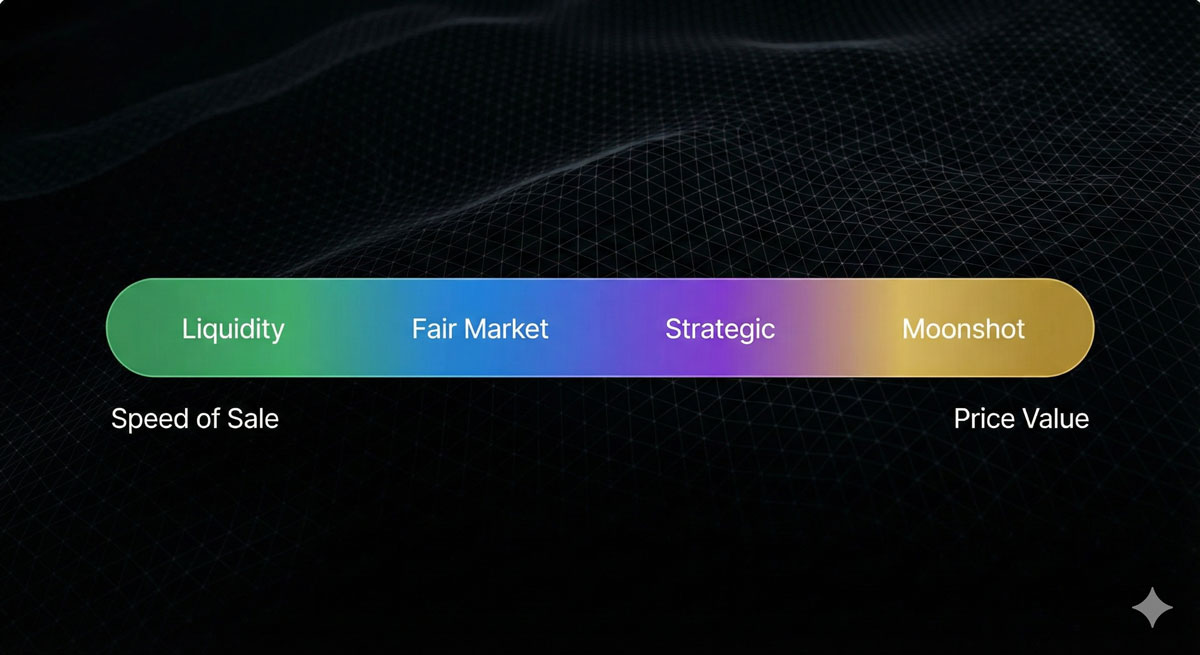
Instead of a single number, this framework gives you four actionable bands: Low (quick exit), Mid (fair market), High (patient/strategic), and Moonshot (rare event). Each tier serves a different strategy and STR goal -- letting you match your pricing to your actual investment objectives.
The STR-Price Tradeoff
At the heart of domain pricing strategy lies a fundamental tradeoff that every portfolio owner must understand:
Higher Prices
- Lower sell-through rate
- Longer time to sale
- More renewal costs
- Higher per-sale revenue
Lower Prices
- Higher sell-through rate
- Faster liquidity
- Lower carrying costs
- Capped upside potential
The Hidden Cost of Holding Out
Illiquidity cost is real and often underestimated. Each year of renewals plus lost opportunities compounds when sellers hold out for unrealistic top-of-range prices. Consider:
| Scenario | Sale Price | Years Held | Renewals Paid | Net Return |
|---|---|---|---|---|
| Quick sale at low range | $3,000 | 1 | $15 | $2,985 |
| Patient sale at mid range | $5,000 | 3 | $45 | $4,955 |
| Long hold for high range | $8,000 | 6 | $90 | $7,910 |
| Never sells (moonshot anchor) | $0 | 10+ | $150+ | -$150 |
The person who sold at $3,000 in year one may have made a better risk-adjusted decision than the person still holding out for $15,000 in year seven -- especially when you factor in the opportunity cost of that capital sitting idle.
Know Your Seller Profile
Not every domain investor has the same goals. Understanding your profile helps you choose the right pricing strategy:
Liquidity-Focused Investor
Goal: Optimize for a target STR (e.g., 2-5% per year) and shorter hold times
Behavior: Accepts more deals closer to low/mid range
Pricing strategy: Price at or slightly below mid-range to maximize inquiries
Best for:
- Large portfolio managers
- Cash flow focused investors
- Those pruning underperformers
- Capital recyclers
Aspirational Holder
Goal: Pursue high or moonshot outcomes, comfortable with low STR
Behavior: Willing to wait years for the right buyer
Pricing strategy: Anchor at high range, negotiate from strength
Best for:
- Trophy domain holders
- Category-defining names
- Patient capital investors
- End-user transition plays
The Four Pricing Tiers Explained
Rather than giving you a single number and hoping for the best, a range-based approach provides four distinct pricing tiers. Each serves a specific strategic purpose:
Low Range (Floor / Quick-Sale Band)
When to use:
- Needing faster liquidity
- Portfolio pruning or de-risking
- Reacting to a weak buyer profile
- Reducing renewal burden
Behavioral guidance:
Consider accepting serious, clean offers in this band if your priority is cash flow or de-risking renewals. This isn't "giving it away" -- it's recognizing that a bird in hand has real value when liquidity is your constraint.
Quick Exit
Mid Range (Fair / Typical Retail Outcome)
When to use:
- Willing to wait a normal amount of time
- Targeting reasonable end-user sales
- Standard marketplace listings
- Average STR/hold-time expectations
Behavioral guidance:
Price BIN or ask in this area for "average" STR/hold expectations. This is your "fair value" zone -- where a motivated buyer with alternatives would likely settle after negotiation.
Fair Market
High Range (Patient / Strong-Fit Buyer)
When to use:
- Clear category match for the domain
- Can hold for a buyer with strategic intent
- Funded startup or corporate buyer scenarios
- Competition for the keyword exists
Behavioral guidance:
Set anchor/ask here but stay open to mid-range outcomes. Expect longer time-to-sale. This tier rewards patience and domain quality -- the right buyer will pay a premium for strategic fit.
Strategic Value
Moonshot (Tail-Event Pricing)
When to use:
- Clear asymmetric upside exists
- Mass-market category potential
- Big-budget sector or unique strategic fit
- Inbound whale inquiries
Behavioral guidance:
Mostly relevant for negotiation framing and inbound whales. This is not a target for normal STR modeling. The moonshot exists to capture rare, high-conviction buyers -- not as a baseline expectation.
Rare Event
Real-World Case Studies
Theory is useful, but examples make it concrete. Here's how range-based thinking applies across different sale scenarios:
How This Looks in Appraise.net: Live Validation
The following case uses an actual Appraise.net range that predicted the sale outcome. View the full public appraisal
High-Range Realization: Sober.ai at $47,000
Actual Sale
The story: A short, on-theme .ai keyword with clear category fit. The buyer had strategic intent -- this wasn't a speculative flip but a foundation for a real business.
Range context: Our AI appraised Sober.ai at $25,000 - $75,000. The $47K sale landed almost exactly at the midpoint -- validating both the range methodology and the "high range" positioning for a quality single-word .ai with health/wellness relevance.
Lesson: Patient holding + quality domain + strategic buyer = high-range outcome. But this took time and wouldn't have happened if the seller had anchored to a moonshot-only price.
Illustrative Scenarios Across the Range
Mid-Range "Fair Value" Sale: Two-Word .com Brandable
Actual Sale
The story: A two-word .com brandable (think "SwiftDesk.com" pattern) listed on multiple marketplaces. The buyer was a bootstrapped SaaS founder who had alternatives and negotiated from an opening bid of $2,800.
Range context: Appraised at $3,000 - $8,000, the $4,500 final price landed in the mid-range sweet spot. The buyer wasn't willing to pay high-range prices, but the domain's quality justified more than floor pricing.
Lesson: Most domains sell in this band. The mid-range isn't "settling" -- it's where supply and demand actually clear. The seller achieved a solid outcome without years of waiting.
Low-Range Liquidity Play: Portfolio Pruning
Quick Exit
The story: A two-word .com from a 200-name portfolio that hadn't received an inquiry in 18 months. The seller was culling underperformers to focus capital on higher-potential names. Sold to a development-focused buyer via DAN listing.
Range context: Appraised at $1,000 - $3,500, the $1,200 sale was near the floor -- but it was real money. The alternative was another 3+ years of renewals chasing a mid-range buyer who might never appear.
Lesson: Low-range sales aren't failures. Sometimes the smart money takes the quick exit. The $1,200 today beats the theoretical $2,500 in year five minus $75 in renewals and opportunity cost.
Moonshot Anchor Gone Wrong
No Sale
The story: An investor anchored to aspirational outliers --"Someone paid $100K for a similar name once!" -- and rejected multiple reasonable offers in the $5-15K range over several years.
Range context: The moonshot tier is for rare events, not baseline expectation. Portfolios where owners only price at moonshot levels end up with near-zero STR and heavy valuation risk.
Lesson: The moonshot price should inform your ceiling in negotiations, not your floor for considering offers. Confusing the two is expensive.
The Psychological Benefits of Range Thinking
Beyond strategy, range-based appraisals provide crucial psychological benefits for domain investors:
Avoids Seller Paralysis
"What if I underprice?" is the question that freezes sellers. A range explicitly acknowledges multiple reasonable outcomes, freeing you to make decisions without the anxiety of "getting it exactly right."
Enables Pre-Commitment Rules
You can set policies before emotions get involved: "Accept anything above the low if I need liquidity; push toward high if I can wait." These rules become decision shortcuts when offers arrive.
Better Negotiation Framework
When you know your low is $3K and high is $10K, an offer of $4K isn't insulting -- it's a starting point within your acceptable range. This reframing alone can save deals that die from emotional overreaction.
Portfolio-Level Clarity
When every domain has a range plus a chosen strategy, you can see at a glance which cohorts are priced for liquidity, which are positioned for fair-market turnover, and which are moonshot holds. This reveals which names are carrying your STR and which are dead weight -- enabling systematic portfolio management across hundreds of names.
Range-Based Portfolio Management
When each domain has a range, you unlock portfolio-level strategic thinking. Instead of managing 200 isolated pricing decisions, you can set cohort-level policies based on your overall STR goals:
Sample Portfolio Strategy
Price at Low Range
Target: 5-10% annual STRPrice at Mid Range
Target: 2-4% annual STRPrice at High Range
Target: 1-2% annual STRThis cohort approach means you're not making emotional decisions on individual domains. You've already decided: "Bottom 20% get aggressive pricing because I want them to move." When an offer comes in at low-range for one of those names, there's no angst -- it's exactly what your policy predicted and accepted.
Persistent Strategy Preferences
Once you decide your STR goal, you can lock it in as a default preference. On Appraise.net, your chosen pricing strategy propagates across all appraisals, list views, and batch results as "My Price" -- so every name is automatically positioned according to your portfolio policy, not ad-hoc guessing.
From Theory to Sliders: Six Preset Strategies
Appraise.net doesn't just give you a range -- it operationalizes the STR-price tradeoff into six concrete pricing strategies you can select with one click:
Higher STR (Faster Sales)
- Aggressive: Quickest sale, most competitive pricing
- Recommended: Balanced approach, emphasizes turnover
- Premium: Higher quick-sale price, good market appeal
Lower STR (Maximum Value)
- Aggressive: Competitive premium positioning
- Recommended: Premium targeting quality buyers
- Premium: Maximum ask for patient sellers
The middle strategies intentionally overlap -- this is the "sweet spot" where quick-sale pricing meets patient-seller entry pricing. Choosing a preset encodes your STR policy into every appraisal, eliminating the need to make hundreds of individual pricing decisions.
Presentation Matters: Charm Pricing & Cultural Targeting
Beyond the range, Appraise.net applies psychological pricing tactics automatically:
- Under $50K: Prices end in 95 or 995 (e.g., $4,995)
- $50K-$100K: Clean $5,000 intervals (e.g., $65,000)
- $100K+: Round $5K or $10K intervals (e.g., $150,000)
- Asian Market Mode: All prices end in 88 or 888 (e.g., $4,888) -- the number 8 signifies prosperity in Chinese culture
vs $5,000
$8,888Asian market
From Abstract Tradeoffs to Concrete Action
The domain market's illiquidity makes single-number appraisals fundamentally misleading. A useful appraisal should help you make policy decisions:
- What to price at for various marketplace listings
- Which offers to accept versus negotiate
- What STR and hold-time you're signing up for
- How to respond when a buyer makes contact
Ranges plus narrative -- "why low, why high, what drives upside" -- arm both investors and end-users with a playbook, not just a number.
How to Apply This in 5 Minutes
- Get a range-based appraisal for your domain (not a single number)
- Identify your seller profile -- are you liquidity-focused or an aspirational holder?
- Choose your pricing strategy -- Higher STR for faster sales, Lower STR for maximum value
- Set pre-commitment rules before offers arrive (e.g., "accept anything above mid-range")
- Lock in your preference so it applies across your portfolio automatically
- Review quarterly -- adjust strategy for names that aren't performing to target STR
The Bottom Line
Range-based appraisals turn abstract STR/hold-time tradeoffs into concrete bands a human can act on. Stop asking "what is my domain worth?" and start asking "what outcomes are plausible, and which am I optimizing for?"
A note on AI + human judgment: Appraise.net surfaces ranges and strategy presets, but always expects you to layer in context -- your traffic data, your market knowledge, your liquidity needs. The goal isn't to replace your judgment, but to structure it.
About This Analysis
This framework synthesizes insights from domain industry professionals, marketplace data, and behavioral economics research. The four-tier model is implemented in Appraise.net's domain valuation system.
Quick Decision Guide
When to sell at each tier:
-
Low Range
Need liquidity, pruning portfolio, weak buyer, renewal burden -
Mid Range
Normal timeframe, typical end-user, average STR goals -
High Range
Strong category fit, can hold, strategic buyer likely -
Moonshot
Inbound whale only, negotiation anchor, not STR target
STR Reality Check
Typical STR by Strategy:
Higher prices = lower STR. Know which tradeoff you're making.
Sample Decision Rules
Set these before offers arrive:
- Accept any offer ≥ mid-range immediately
- Counter offers in low range with mid-range ask
- Only hold for moonshot if runway > 3 years
- Accept low-range after 2+ years without offers